
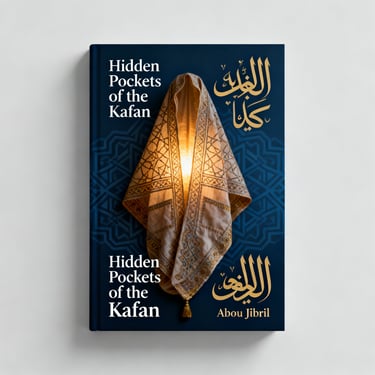
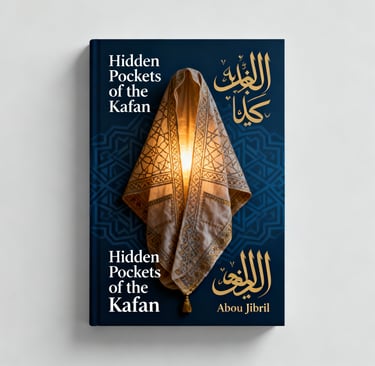
Hidden Pockets of The Kaffan
Abu Jibril
4/7/20266 min read
Author’s Note
This book is an invitation, a quiet calling to look beyond the surface of life and to explore the hidden chambers we each carry within. The “pockets” named here are not final truths but reflections, fragments of the vast inner landscape that shapes our journey through existence, loss, love, and transformation. In writing these meditations, I have sought to honor the complexity and mystery of the soul’s passage, acknowledging both its shadows and its light. Like the kafan, simple yet profound, these pockets hold what is essential and eternal, even when hidden from ordinary view. May this work serve as a companion for those who wander through the silent places of the heart, and may it inspire the courage to embrace all that we carry for all that we must one day release.
With humility and hope,
Abou Jibril
Overview
“When the soul lies down in that grass, the world is too full to talk about. Ideas, language — even the phrase each other — doesn’t make any sense.” Rumi
Regret is a curious companion. It does not enter with ceremony, does not seek permission. It arrives quietly, as though it has always belonged, and establishes itself in the unlit corners of our memory. We tell ourselves that when the final garment is drawn across us—the kafan, plain and unadorned—these burdens will be laid aside. But this is self-deception.
The shroud is simple by design, seamless in its renunciation of the world. Yet in its austerity it reveals an unsettling paradox: what is bound in cloth is only the body, not the choices that shaped it. For while the kafan bears no pockets, the life it enfolds is lined with invisible ones. Regret, restraint, silence, and omission—these are stitched into the fabric of being, carried long after the moment in which they were sewn.
Every existence, however ordinary or exalted, accumulates these hidden folds. They are formed not only of errors but of absences: the truths withheld, the gestures unmade, the mercies we failed to extend. Though weightless to the hand, they carry a density that no stone can rival. It is not the linen of burial that contains them but the self, which no ritual can strip away.
To live, then, is to cultivate these unmarked interiors. To die is to meet them without distraction. The shroud presents no argument to the world; it leaves only silence. Yet in that silence, a reckoning occurs—not for the body laid to rest, but for the life that preceded it. And when the body has vanished, these pockets remain: not in the grave, but in the memory of others, in the reverberations of choices and non-choices, in the echo left behind by our absence.
Perhaps the lesson is not ascetic emptiness but transformation. If the kafan cannot carry what matters most, we ourselves must choose how that weight is borne. Regret, when acknowledged, becomes something other than a private burden; it becomes instruction. It insists we recognize limitation, that we wrest meaning from imperfection before surrender makes it final.
“Do not seek in the world what the world cannot give.
When they wrap you in your shroud,
only your deeds will be your companions in the grave.” Farid ud-Din Attar
Prologue:
The kafan is meant to be plain. It has no embroidery to boast of, no stitching to flatter the eye, no distinction between rich and poor. In its folds, every life is equal. At least, that is what we want to believe. Yet it is not so simple. For though the shroud bears no pockets, the human being within it is stitched with countless hidden recesses—spaces invisible to others but impossible to lose. These are the true linings of existence: secrets carried until breath falls silent, regrets folded tightly into the marrow, truths never spoken aloud.
The dead do not rise to empty their garments before burial. What goes unspoken, unlived, unredeemed remains with them, silent passengers crossing the final threshold. If the shroud is honest in its emptiness, the soul is its opposite: endlessly heavy, crowded with what was withheld.
It is here, in this paradox, that a haunting truth reveals itself: we pretend the kafan makes us equal, yet the weight of invisible pockets divides us far more than wealth or status ever did. Some depart light, their silences reconciled, their choices lived fully enough that little remains concealed. Others descend into the earth with pockets bursting, heavy with missed chances and unshed words, their true weight borne now by memory and by those left behind.
The kafan teaches us simplicity; the pockets within ourselves reveal complexity. And it is in the tension between the two that the meaning of a life may be sought.
Part I – The Weight We Carry
“Don’t get too close to what you regret.
Stand in awe before the pain — it will cleanse you.
Every wound invites you to remember
the Beloved who alone can heal.” Rumi
Chapter 1: Pocket of Regret
Regret is not always sudden. More often it creeps in as a shadow lengthening across the floor, stretching its reach as light recedes. Sometimes it appears small—a missed call, an unsent letter tucked into a drawer, a silence maintained out of pride. But with time, these fragments gather into something immovable. What is left unfinished lives on, even when every other possession is surrendered.
Regret is perhaps the most familiar of the pockets we carry, but guilt occupies a closely intertwined corner—often heavier, sharper, more corrosive. Where regret lingers as a quiet ache over what was lost or not done, guilt sears with the knowledge of what we have done or failed to prevent. They are siblings, each stitching its seam into the fabric of the soul, each coloring memory with unseen stain.
The pocket of regret swells with chances that slipped through grasp, words that were swallowed, moments of courage deferred into silence. It is a space filled with “if onlys” and “what might have beens.” In that interior fold lies the portrait of the self as it wished it had been—braver, kinder, wiser, more present. But it is a self forever out of reach, ghosted by time that moves relentlessly forward.
Regret is not a single event but a lingering companion, a silent traveler that shadows each step once memory awakens. It gathers in silence like dust in corners rarely swept—always there, subtle, persistent. Its nature is slippery, shape-shifting with the seasons of thought: now heavy and obvious, now thin as air but no less suffocating.
Regret does not mark only the grand losses but nestles also in the creases of small betrayals—a sharp word left unsoftened, an apology withheld at the threshold of reconciliation. Its language is repetition: scenarios played and replayed, the mind’s ceaseless attempt to rewrite what was spoken or to recover what was never dared. To regret is to become both archivist and playwright of one’s own failings, staging soliloquies in the theater of introspection while the audience of the heart remains unsatisfied.
There is something sacred in regret, for it forms a bridge between what is and what might have been. Philosophers speak of time as unidirectional, but regret moves backward, folding the past into the present, a gentle violence that refuses to let go. It teaches humility, reminding the soul of its incomplete knowledge, its dependency on opportunities that can never be recuperated.
In truth, regret is sewn into the very fabric of existence—a hidden pocket of the kafan, unseen by mourners but carried close to the departing soul. It is tucked away in the final shroud not as a garment of shame, but as a testament to a life lived with longing and imperfection. This pocket, imperceptible to the eye, carries the weight of all we wished to say and do, pressed softly against the heart in its final journey.
Regret, if left unexamined, ferments into bitterness or self-reproach. Yet, if held with tenderness, it becomes a source of insight—a guide to what matters most. In this way, the pocket of regret does not simply imprison; it illuminates. Each pang, each wince, is a teacher—pointing gently to the better angels of intention and reminding us that even amid loss and longing, the soul yearns not for perfection, but for a fuller presence in each fleeting moment.
In its truest sense, regret is a confession of hope: an acknowledgment that, despite missteps and missed chances, there remains within us the longing to become—again, and ever more truly—the selves we glimpse in dreams and prayers, just beyond the reach of our trembling hands. The kafan, with its secret pockets, carries these yearnings on our behalf, ensuring that none of our unfinished moments are truly lost, but rather, are tucked away lovingly for eternity’s keeping.